

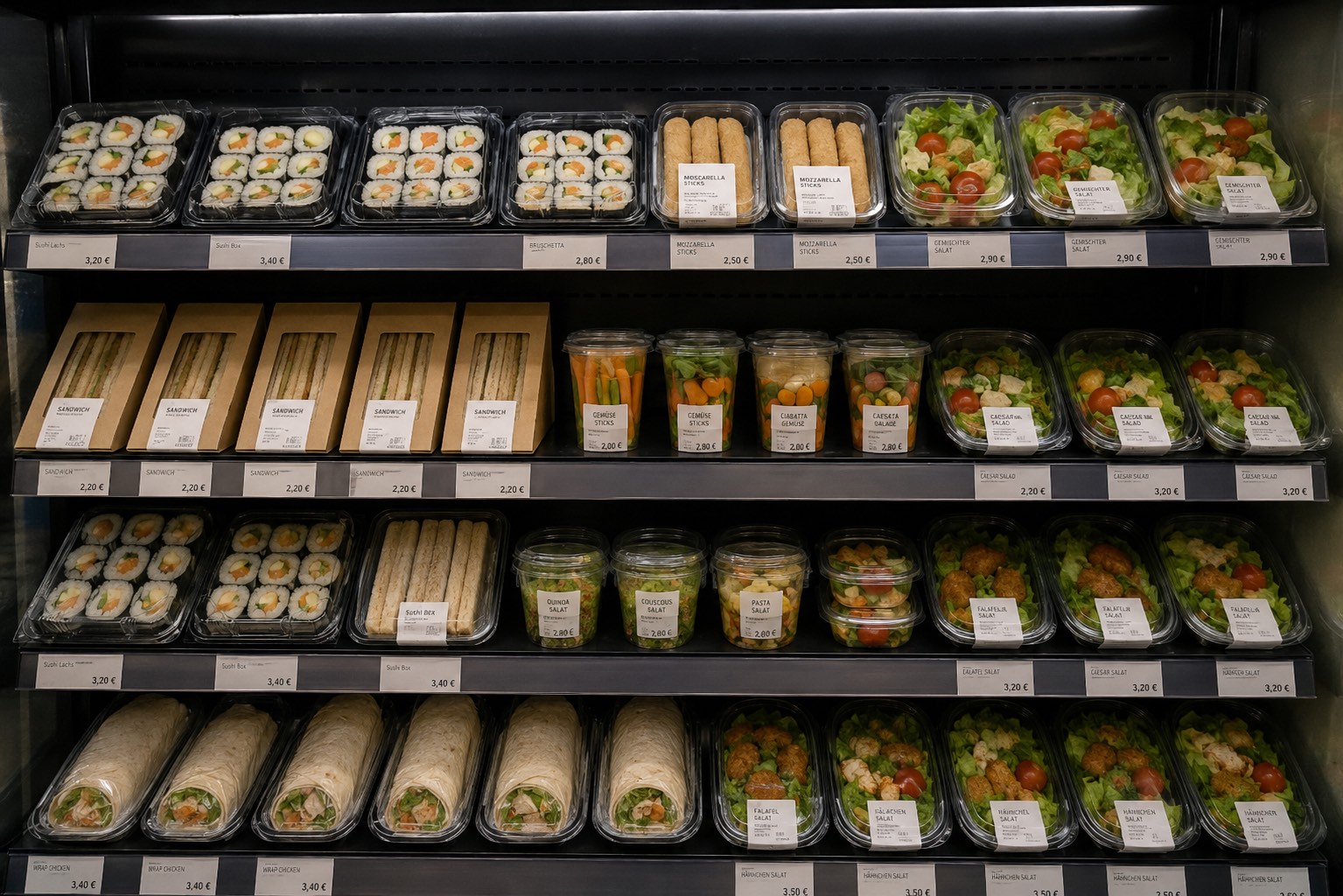
For food-to-go and fresh-food manufacturers
Supply every sales outlet to demand, from sushi to salad.
AIPERIA forecasts sell-through by product and sales outlet and turns it into concrete delivery and assortment quantities. Less waste, higher availability, more contribution margin, across thousands of locations.
Every location behaves differently, and the goods will not wait.
Sushi, wraps, bowls and salads sell on impulse. Weather, day of the week and the location of the sales outlet decide the daily sales, and the shelf life leaves no second attempt.
A maths problem, not a matter of effort
The same product can vary by more than half on the same weekday in the same store. More than 150 factors act on demand by product and location, and the network ranges from the small city-centre store to the large supermarket with its own catchment area. Anyone planning on experience or rolling forecasts delivers too much to one outlet and too little to another. With a short shelf life and the full inventory risk, both cost margin immediately. This is exactly the calculation AIPERIA takes on.
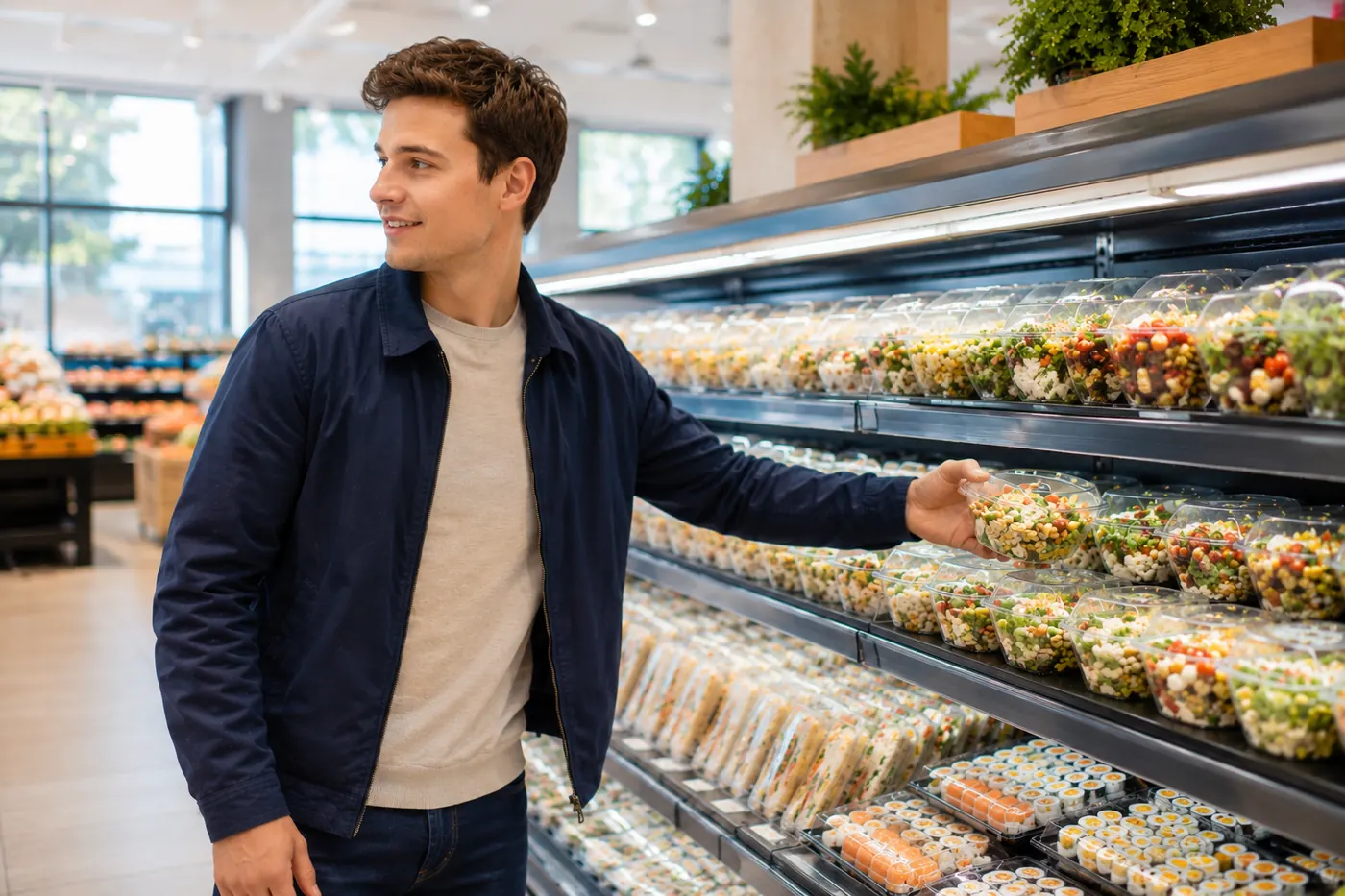
From sell-through to the shelf of every sales outlet
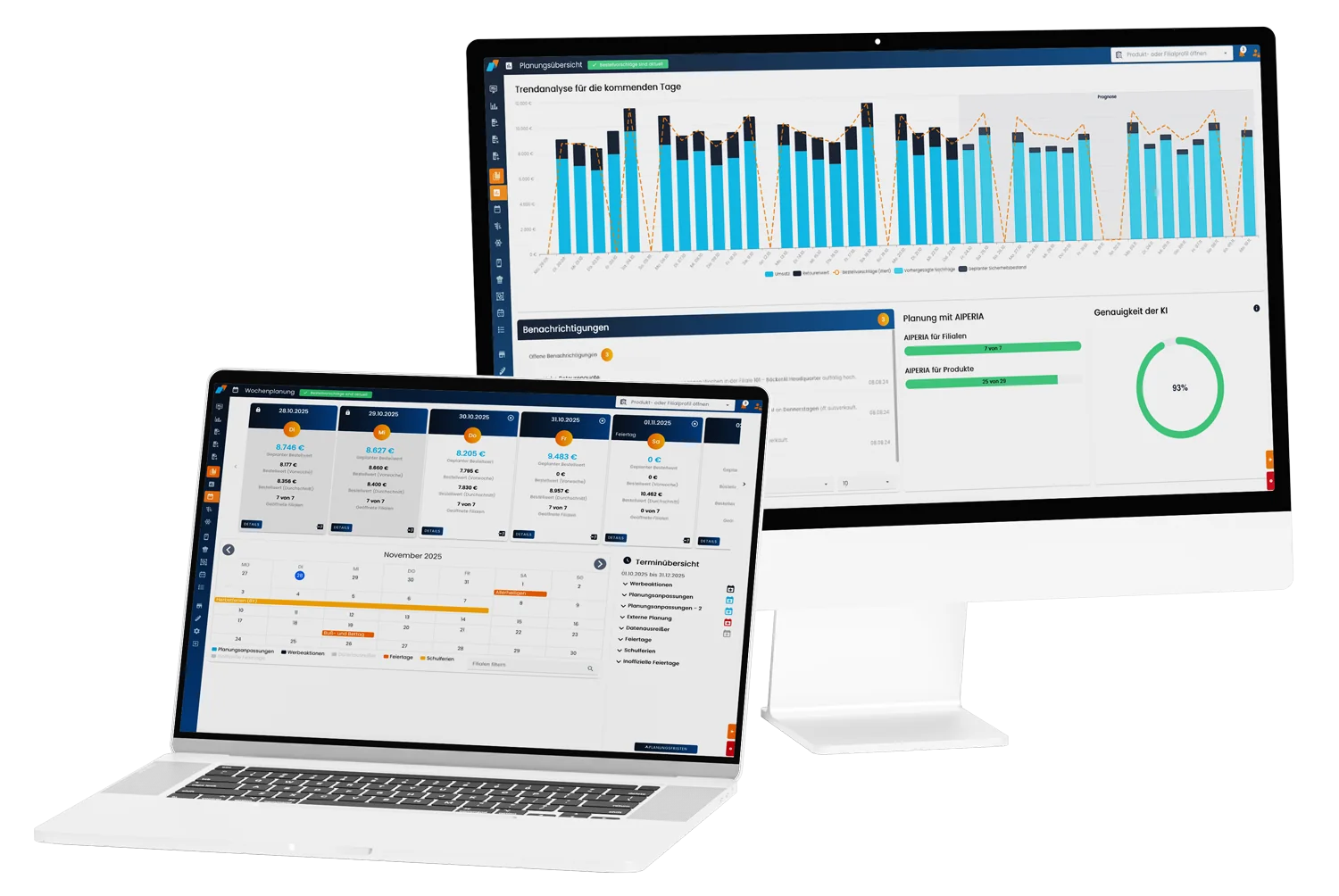
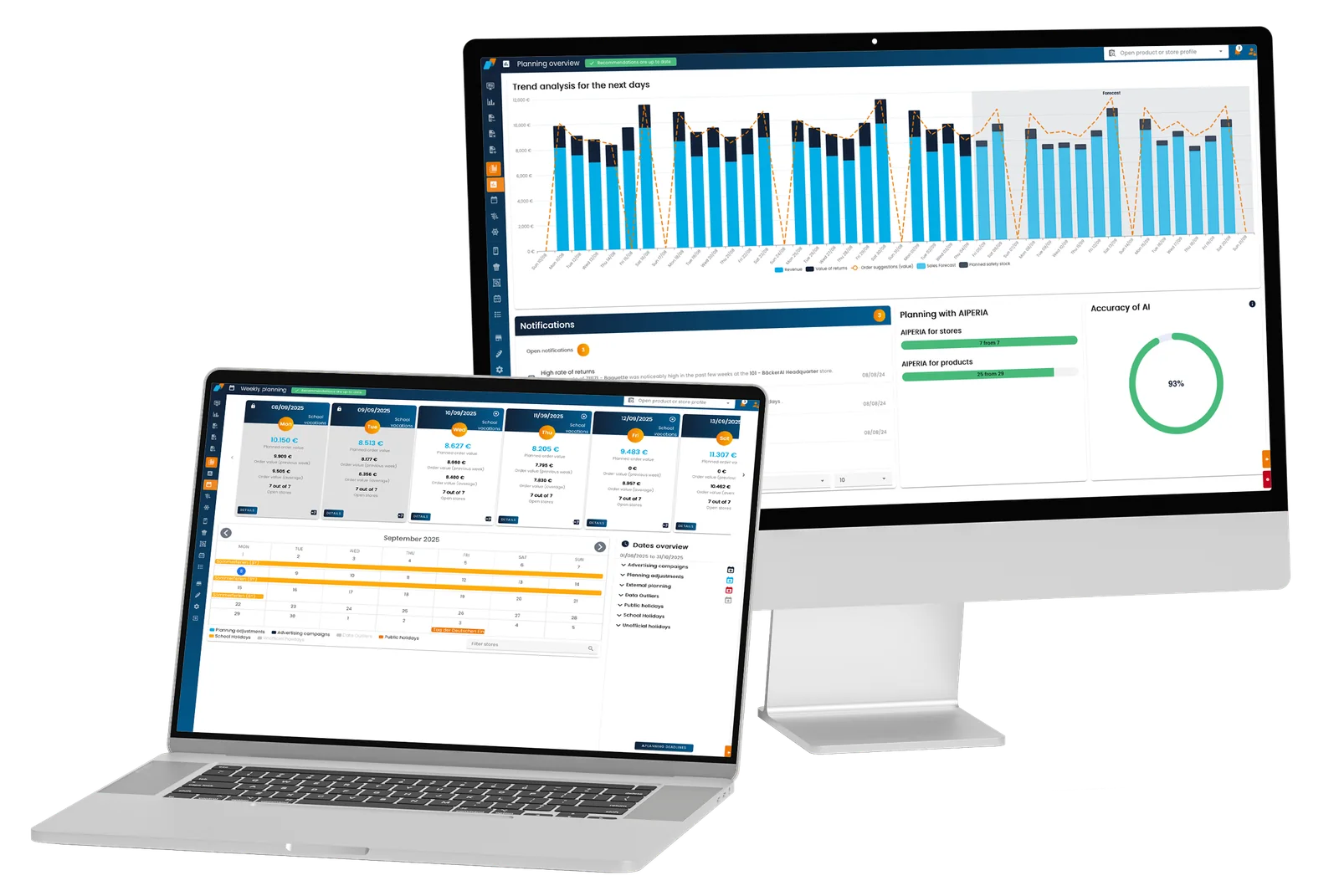
AIPERIA forecasts demand by product and location, to the day and up to several weeks ahead, drawing on more than 150 external factors such as weather, public holidays and seasonality. The forecast becomes concrete delivery and assortment quantities that flow straight into your ordering and production processes.
Assortment and quantities
Store-level control instead of one-size-fits-all
- AIPERIA optimises assortment breadth and delivery quantity by sales outlet, rather than rolling out a standard range across all locations.
- Substitution effects feed in: which variant is bought when the preferred one is out of stock. That raises availability without increasing waste.
- Planning is geared to profit, not revenue: the cost of goods is factored in, especially with a short shelf life.
Distribution and scaling
Manageable across thousands of third-party locations
- Heterogeneous store networks across several retail partners are segmented into workable clusters, rather than treating every store individually, which would not be logistically viable.
- Daily patterns, location profiles and regional effects form the basis for delivery quantities.
- Control scales across the entire network without handing distribution steering out of your hands.
How Natsu brings availability and waste into balance

Natsu Foods supplies more than 1,200 sales outlets from its own production, including the Rewe and Edeka groups, on a direct-to-store commission basis. The Neuss-based company handles shelf maintenance itself and carries the full inventory risk until sell-through. With AIPERIA, Natsu steers assortment and quantities at store level and increasingly automatically, taking substitution effects and external factors such as weather and the location of the sales outlet into account.
With planning that takes substitution effects in our product range into account, we can significantly improve the availability of goods without increasing the number of returns.
Initial consultation
How much more revenue is there in your sales outlets?
In an initial consultation we look at your assortment, your sales outlets and your distribution and show you where AIPERIA can help.
Let's talkFree · 30 minutes · No obligation
Clear value for management and planning

Steer strategically
Management and sales
- More contribution margin from the same assortment, through store-level control and profit-oriented planning.
- Transparency across all the metrics of the business, from the sales outlet to the retail partner.
- Clearly defined KPI routines with retail partners build trust and speed up coordination.

Deliver in day-to-day operations
Planning and demand management
- Noticeably fewer manual interventions: assortment and quantity planning run largely automatically.
- Location specifics such as differing shelf space are planned in, rather than reworked by hand.
- Manageable exceptions: promotions, public holidays and weather conditions are accounted for in the forecast.
You set the targets, the autopilot supplies the quantities
AIPERIA automates delivery and assortment control in normal operation. Exceptions such as public holidays, promotional weeks, sudden weather changes or data gaps are surfaced through alerts and can be adjusted specifically.
- You set your targets, for example for target availability per sales outlet. AIPERIA works out the optimum between availability and waste for each product and location.
- Delivery and quantity recommendations can be adjusted at any time, through an intuitive interface and without technical knowledge.
- Planning is geared to contribution margin: the cost of goods and the full inventory risk of a short shelf life are factored in, not just revenue or availability at any price.

Up and running quickly, cleanly integrated
Food-to-go: convenience in the chiller, high complexity behind the scenes
The AIPERIA analysis on planning in the ultra-fresh category
Drawing on real market data, the analysis shows why food-to-go is barely manageable without AI and how the trade-off between availability and waste can be resolved.
- The five factors that make food-to-go so complex: volatility, seasonality, shelf life, cold chain and cyclicality.
- Why the strongest store turns over a multiple of the median one, and how a cluster logic makes that gap usable.
- How optimising assortment breadth alone can cut the waste rate by several percentage points in practice.
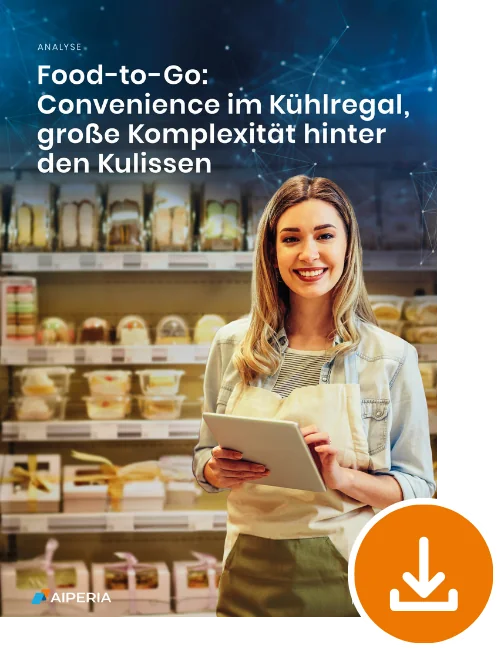
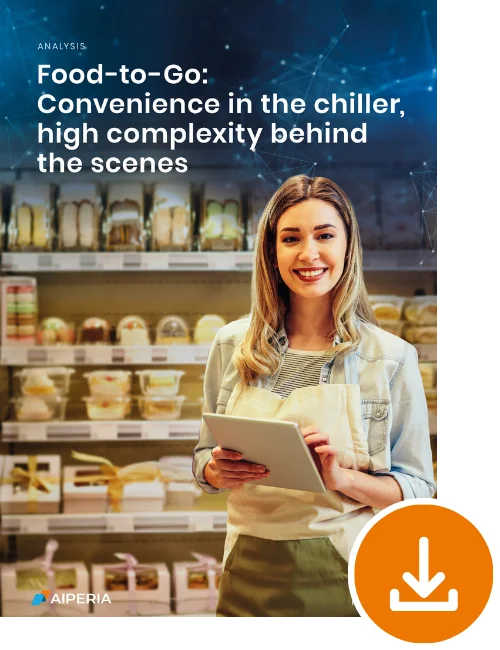
Download the white paper now
You will receive the white paper immediately afterwards.
Frequently asked questions
For providers in the fresh and ultra-fresh category that supply retail at their own inventory risk, such as food-to-go manufacturers with sushi, wraps, bowls and salads. The solution fits everything from mid-sized ranges to networks with thousands of sales outlets.
For profit. AIPERIA factors in the cost of goods and does not aim for revenue or unbroken availability at any price. With a short shelf life this is decisive.
AIPERIA takes into account which products substitute for one another. This improves availability without increasing the number of returns.
AIPERIA takes more than 150 external factors into account, including weather, national and regional events as well as the catchment area of each sales outlet.
Yes. The solution is compatible with common ERP and merchandise management systems. Via the AIPERIA ETL we also connect bespoke system landscapes and in-house developments.
Initial effects on availability, waste and planning effort usually show within the pilot period of a few weeks, provided data access and processes are set up cleanly.
Contact
Let’s bring availability and waste into balance. Let’s talk.
We will show you, using your own data, where contribution margin lies in your assortment, quantities and distribution.
Let's talkFree · 30 minutes · No obligation